Showing posts with label platform. Show all posts

Wednesday, February 20, 2013

Modern Magic

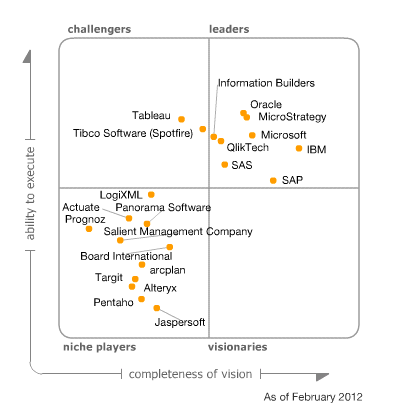
Recently the 2013 Gartner Magic Quadrant came out for Business Intelligence and Analytics. I'm not going to get into the subtle nuances of what makes a Gartner Magic Quadrant "magic", but if you've heard of a vendor, chances are they are on here. If that vendor is fortunate enough to be in the upper right, chances are they are a safe bet, and if they are in some other area you'd better be buying them for a very specific use case.

Courtesy Alteryx.
My first thought after looking at this was that this quadrant doesn't make anyone look all that magic. To wit...
  • 40+% of those rated are "leaders". One can only imagine how populous the "followers" box must be.
  • 90+% of those rated are in half of the categories. Not exactly exploring the studio space on this graph, huh?
  • There hasn't been a visionary in the business intelligence space since 2009 (there were 2 back then). Seems like a real growth opportunity.
Thus far the only purpose this visualization serves is reminding me of the old adage that "half of all doctors are below average." The good news is that this heavy clustering in the upper right and lower left is nothing new.
2012 courtesy of Tableau.


2011 courtesy of The Dashboard Spy.
This brings up the the more interesting point, which is the the addition of "Analytics" to this year's criteria. It seems fairly obvious from looking at the last few years' worth of quadrants that this was just a concession by Gartner that Tibco and Tableau could no longer be shut out of the leaders quadrant even though they don't fit the model of a traditional BI software provider. Theoretically this means that Gartner has finally given a nod to a meaningful change in the market. Pessimistically it sounds like they realized their model was broken and this was the easiest way to cover up that people were buying too much software that wasn't in the Magic Quadrant's most magic quadrant.

This does leave us with a rather interesting situation where solutions that were formerly considered departmental (tools like Tableau, Qlikview, and Tibco) might now be tasked with meeting enterprise needs. Clearly the price tag is attractive, but I have a feeling that all of the same reasons keeping large enterprises from going to the cloud (maturity, FUD, and the difficulties in extending and customizing solutions) are going to keep these smaller vendors serving marketing or HR while Cognos and BusinessObjects present the majority of data within most organizations.

In the end, I think Gartner's Magic Quadrant continues to serve the purpose it always has, which is a security blanket for those in procurement who won't buy any software that isn't at least mentioned. Only time will tell if that security blanket is getting a little thread-bare now that a vendors presence on here could mean they could be a safe bet for a large enterprise solution, a small or medium-sized enterprise solution, or even a departmental solution.

For an SAP-specific slant, please check out Dallas Marks's thoughts.

Sunday, June 10, 2012

Culling the Catalog

Not that long ago (OK, that long ago) the BusinessObjects portfolio consisted of just one tool. In the last 10 or so years, that portfolio has become a bit... bloated (it's OK for me to use that word in the same way it's OK for a flight attendant to call another flight attendant "the stewardess word"). While the robust growth of the product count was justified before (BusinessObjects buying Crystal Decisions was HUGELY important and obviously SAP buying BusinessObjects was the right move in that market), SAP has begun to show that it shouldn't continue to support the full breadth of its home-grown and acquired business intelligence catalog.

The first hint at this culling of the herd was the release of Crystal Reports for Enterprise (CRE) with it's BI4 platform update. This new tool looked exactly like Webi and Crystal had a baby and got the best DNA from each parent. The second, and more obvious signal is the eventual convergence of Xcelsius into the Zen product. With these releases SAP has signaled that they recognize just throwing half the product sheet out isn't good enough and that they need to step back and see what customers actually need NOW, not what they needed years ago.

So what do customers want/need? I think SAP has nailed this spot on by focusing on functions and users rather than tools.

  • The core of BI consists of canned reports, currently serviced predominantly by Crystal Reports and Web Intelligence (Webi). CRE is clearly a first stab at converging those two toolsets into something that can be developed by developers in (hopefully) a block or line format with pixel-perfect visualizations from any data source and deliverable in any number of places.
  • Self-service BI used to be the domain of Web Intelligence but quite frankly, it just isn't easy enough to use for most users. Unless you are a power user and live and breath the stuff, you don't want to generate a query and format a report. You want to see something more like Explorer, where you search for "Paris leather sales" and it spits you out a number. Power users want to go deeper, but they also want a more consumer-like experience, and Visual Intelligence (or Visi, part of the Explorer family) is going to make those people very happy. For those power-power users, SAP is also adding Predictive Analysis, something it can tightly integrate with its portfolio and not have to pass money down the line because they're just licensing another vendor's technology.
  • Finally, there are BI applications, which go beyond just delivering data into something featuring more interactivity and extensibility than we've been able to provide before. If Zen can meet its somewhat lofty goals while still allowing non-developers to develop (as Xcelsius does), then I can buy into bringing all of those use cases under one umbrella.
Some of you will (rightly) point out that I've opened a blog about "thinning" the BusinessObjects portfolio by listing 4 new products (CRE, Visi, Predictive Analysis ,and Zen) but that really had to happen. Overextending tools like Webi (which started as self-service and evolved into canned reports) is what got us in this mess in the first place. SAP is basically reinventing their portfolio to solve current problems without tossing aside the investments so many of us have already made into a specific tool.

Are there still open questions? Sure. Where does Exploration Views fit in (for my money, it is squarely between Core BI and Self-Service BI)? How do they invest in the future without letting their current tools die on the vine (as many have accused Xcelsius of doing)? How do they make sure they don't bet on the wrong horse (something something iPads and Flash)? When are they going to get the mobile piece right (they are getting closer but aren't quite there all the way across the platform)? When will Deski actually be blighted from the face of the earth (not soon enough)?

I know some are confused by the direction SAP is taking its BI portfolio, but I think this is just because most people simply haven't bought into SAP's new commitment to renewal. We aren't used to an enterprise vendor willing to invest so heavily into a completely new direction. Will this new direction give them some new license sales in the short term? Sure, but I don't think enough to offset the cost to develop it (most people with Explorer licenses don't even have to pay for Visi). SAP knows where they need to be in order to lead the market in 10 years, and they're willing to buy into that vision early.

Tuesday, May 22, 2012

SAP as a Platform (SaaP?)

If you were wondering why I hadn't posted my thoughts on last week's ASUG Annual Conference/SAPPHIRE  Now, it's because I gave them over at ASUGNews.

http://www.asugnews.com/2012/05/22/saps-platform-play-why-bi-pros-should-be-bullish/

Thanks so much to Tom Wailgum for looking past all of the swear words in my first draft and removing this link from the Ricky Bobby quote (NSFW)

Wednesday, March 28, 2012

Fear, uncertainty, and cloud

I recently read an article entitled CIOs fear business leaders see cloud as way to circumvent IT (h/t to Jon Reed who h/t'd Vijay Vijayasankar) and I was floored.

What Sooraj wrote was:
The study says CIOs are concerned that cloud provides business teams with a way around IT teams by acquiring cloud services on their own, which undermines the strategic partnership they are trying to build with business leaders.
But what I read was:
With lines of business increased control over IT spending and IT's complete inability to meet the needs of the modern business in a timely and pleasant fashion, here's just one more reason why I fear not only for the office of the CIO generally but for my job specifically.
I find that more than a little disheartening -- I've long said that working like you fear for your job is the best way to do a terrible job. That said, everyone's got kids to feed, so how does IT survive this "whole cloud thing" and leave the business better off to boot?

  1. Manage these cloud connections internally. Dominic Wellington recommended this at the end of the article, and rightly so. Lines of business don't want to manage their cloud services or anything else technology-related, but often they must in order to get things done. Managing cloud services needs to have some policy and procedures around it certainly, but taking 3 months to get around to filling out a web form that takes 5 minutes isn't going to cut it.
  2. Make everything simpler. Whether it's Steve Jobs talking about saying "no" to lots of things, or Vishal Sikka talking about removing layers, it isn't hard to find smart people willing to talk about taking complexity out of your business as a good thing (when done thoughtfully, anyway). Doing extra things can be dumb. Tactically employing "the cloud" can help you do less dumb things. 
  3. Take this opportunity to restructure IT intelligently. An investment in the cloud doesn't have to just transform the way your company does business, it can also transform the way you deliver services to your business. As a company moves to the cloud, it probably needs less pure-developers for day-to-day operations and should invest in skills such as security and configuration. This will also allow your best developers to move onto more interesting and fulfilling opportunities, like mobile development, and your less good ones to do something... less developer-y.
The cloud has put CIOs on notice, as well it should have, but being put on notice and being doomed aren't necessarily the same thing. Like with most things, proactivity is the key. Embracing the cloud now may prevent it from putting you in a choke-hold later.

Wednesday, February 29, 2012

Leap Day 2016 Predictions for SAP BI


Over the last couple of months all sorts of analysts and bloggers have reviewed their 2011 predictions and made some new ones for 2012. I'd like to be the first to write about what I see happening in the SAP Business Intelligence landscape over the next 4 years, until the next Leap Day on February 29, 2016.

Culture Shock

SAP will announce that it is buying a company with a strong culture that doesn't mirror that of SAP's. Pundits  (and SAP) will beat their chests and declare that this new acquisition's success will force SAP to develop a more open culture. Nothing will actually change.

Mobility

SAP will create a shadow subsidiary that will lever up and buy Apple. The next day they'll stop shipping mobile devices and everyone -- consumers, and enterprises alike -- will just give up the whole mobile thing.

Rise of the Developer

SAP will transition itself into a Development Platform Provider more than a Software Solutions Provider. This will be great for small development companies, but not great for companies who don't have a ton of developers in house. Fortunately, the apps they need will be cheap (and won't need all manner of customizations).

Big Goals

Once SAP takes over the number two spot in databases, they'll set their sites a little higher and will try to become the premier provider of men's hosiery in former-EU countries. (Former EU? That's a whole different set of predictions).

Armageddon

The Mayans retained Oracle to be its solution provider for the big ending, but they won't be able to afford the change when Oracle recalculates their maintenance and license revenues based on the Mayans hardware and software needs scaling back post-"End of the World." The Mayans' lawsuit will drag on in the courts, and we will all get to breathe easy a little longer.

Thanks in advance, Larry.